Leaving Home
January–March 1943
In this chapter, Austin’s own words appear in the boxed letters, spelled as he wrote them. All added explanation is set apart in green notes labeled Historical note so the two voices are never mixed.
ROOSEVELT, CHURCHILL MEET IN CASABLANCA
Allies Demand Unconditional Surrender of Axis Powers
— Late January 1943
On the last day of January 1943, while President Roosevelt and Prime Minister Churchill were finalizing their demand for the complete surrender of Germany, Italy, and Japan, a twenty-two-year-old farm boy from Cherry, in Lauderdale County, Tennessee, sat on a southbound train and began the first letter of his war.
Historical note — late January 1943Casablanca: “unconditional surrender”
From 14 to 24 January 1943, President Franklin D. Roosevelt and Prime Minister Winston Churchill met at Casablanca, French Morocco, with their Combined Chiefs of Staff. On 24 January they announced that the Allies would accept nothing less than the unconditional surrender of Germany, Italy, and Japan. American newspapers were still carrying that demand when Austin boarded the train.
The same week, the war’s other great turning point reached its climax. On Sunday, 31 January — the day of this first letter — newly promoted German Field Marshal Friedrich Paulus surrendered the southern pocket of the Sixth Army at Stalingrad. The last northern pocket would fall on 2 February. U.S. front pages that Monday morning led with the capture of Paulus and the destruction of an entire German army.
Austin H. Winn wrote in short, interrupted bursts as the cars rolled through Georgia.
Hello Everybody, It's now 1 o'clock P.M. Sunday afternoon. I am on the train about Waycross Ga. Had a good nite sleep last nite. The train is stopped rite now but if my handwriting gets to jumping you'll know we've started again. This sure is a nice trip. There are about 10 boys on here going to the same place I am. They all seem to be nice boys. (We're moving) I have eaten breakfast and intend to eat lunch in a few minutes. Well hope Daddy is feeling O.K. This train ride like an aeroplane I suppose. We're bouncing around and up and down. It felt kinda funny about 12 o'clock the first nite. I'm use to it now. We are cutting the Dining Car off in about 30 minutes so I had better eat lunch first. We pick up another about 4 this afternoon. Will write more as soon as I reach Miami if I have time. Love Austin
Historical note — 31 January 1943, Waycross, GeorgiaWaycross was a major Atlantic Coast Line junction in southeast Georgia, the usual place where Chicago–Florida and Midwest–Florida trains joined the main line toward Jacksonville. From Jacksonville the Florida East Coast Railway carried passengers the last 350 miles down the coast to Miami. The family archive titles these pages “The Dixieland.” In 1943 that was not yet an official train name — the Florida East Coast’s Chicago–Miami streamliner was then the Dixie Flagler, later renamed Dixieland in 1954 — but the heading fits the route: a Florida train running through Waycross and Jacksonville.
Troop movements had first claim on Pullman space and dining cars. Cutting a diner off mid-run and picking up another later in the day was ordinary wartime railroad practice. Austin’s hope that “Daddy is feeling O.K.” is the first sign in the letters that W. H. Winn was already ill at home in Cherry.
By evening he was in Jacksonville. The Florida heat was already pressing in.
I'm in Jacksonville, Fla., now. The scenery sure is beautiful. Every thing looks fine & dandy. I have a seat with an Ensign of the Navy. The Negroes are washing the windows of the car now. It sure is hot! Will get to Miami tonight about 10:20 I think! By By
Historical note — 31 January 1943, JacksonvilleAn ensign was the most junior commissioned rank in the U.S. Navy, equivalent to a second lieutenant in the Army. Jacksonville in 1943 was crowded with sailors from Naval Air Station Jacksonville, Naval Station Mayport, and the yards along the St. Johns River. A 10:20 p.m. arrival in Miami was a standard evening schedule on the Florida East Coast.
Station and coach cleaning in the Jim Crow South was commonly assigned to Black railroad laborers. Austin recorded what he saw in the language of his time and place. He wrote a third scrap that same night, just before the car lights went out at 9:00, and put his new Army address on the envelope.
10 minutes till 9:00 o'clock and lights go out at 9 o'clock. I don't have time for anything but my address which is on the outside. Will write as soon as possible. How is everyone? Love to all, AustinPvt. Austin H Winn 1128 T.S.S. Flight 388 - B.T.C. Miami Beach, Fla. Mr & Mrs W.H. Winn Route 2 Henning, Tennessee
Historical note — reading the first Army addressPvt. is Private, the rank of an enlisted man who has not yet been rated. T.S.S. (also written TSS) is Technical School Squadron — an administrative training unit of the Army Air Forces Technical Training Command. Flight 388 is the small drill unit inside that squadron; a flight at Miami Beach was commonly about 100 to 125 men. B.T.C. is Basic Training Center. Later envelopes add AAFTTC (Army Air Forces Technical Training Command) and BTC #9, the official number of the Miami Beach basic-training installation.
Mail to a trainee had to carry the squadron and flight. Without those lines a letter could sit in a base post office while the man himself had already been marched to another hotel. The return address on the family’s envelopes — Route 2, Henning — was the rural mail route. Home itself was the community of Cherry.
He arrived in the dark, one more anonymous face among the thousands pouring into South Florida. The train had carried him away from the familiar fields and the quiet store at Cherry. Behind him lay the daily rhythm of livestock and cotton and the sudden emptiness of a house that had just sent its son to war. Ahead of him waited a world he could only imagine.
What Austin Found in Miami Beach
In early 1942 the Army Air Forces had taken over nearly every hotel and apartment building on Miami Beach. By the time Austin arrived, more than three hundred hotels had been converted into barracks, classrooms, and mess halls. Luxury lobbies became orderly rooms. Swimming pools were used for physical training. The same palm-lined streets that once hosted winter tourists now echoed with marching feet and the commands of drill sergeants. Nearly half a million men would pass through this “Boot Camp in Paradise” before the war ended.
Historical note — Army Air Forces, Miami Beach, 1942–43The Army Air Forces Technical Training Command opened the Miami Beach training center in February 1942. LIFE magazine counted 332 resort hotels under lease; a 1943 congressional inquiry put the figure still higher when apartments were included. At the peak, about 85 percent of the Beach’s hotel rooms — and a quarter of all hotel space in Florida — belonged to the Army. Golf courses became drill fields. Hotel dining rooms became mess halls. One-fifth of all AAF enlisted men and one-fourth of its officers would pass through the city before the hotels were released in 1944–45.
Austin’s first barracks was the Randall Hotel, seven stories up, six men to a room, stairs instead of an elevator for the daily rush to formation. The ocean was, as he put it, within “hollering distance.” Patrol planes and small naval craft were visible offshore. German U-boats had hunted along the Florida coast through 1942; by early 1943 the worst of that campaign had been checked by convoys, blackouts, and air patrols, but the watch had not been stood down.
Life settled into a hard, repetitive pattern within days.
Dear Mother and Family, I suppose you got a letter yesterday from me but I but I found a little more time so thought I would drop you another line or two. I'm getting along fine and liking the service swell. We have been so busy I haven't had time to think about home yet. I am getting blistered from the sun. There are so many cadets arriving here on such short notice we haven't been issued any clothing yet. We are confined to quarters for our work then we can go around on the Post when off duty. We are in hollering distance of the ocean. When we eat we walk right up close enough to throw a rock in the water. We can see patrol ships & planes in and over the ocean at all times. There are six boys in my room on the 7th floor of the Randall Hotel. We have to run up and down those stairs every so often. I think we will be in perfect health when we leave here. We will probably not get any closer to an aeroplane here than we did at home. We are having the regular army drilling only more of it than regular soldiers get. […] We sure do have plenty to eat and am I eating plenty too. We have to keep our rooms tidy at all times and shave every day before drill. All six of us have a time trying to use the same bath room in about 15 minutes each morning. (Puff Puff) While I was writing just now a sergeant Hollered everybody down stairs. Down we ran and they issued us a sheet. We will get pillow cases tomorrow if we're lucky. Love Austin
Historical note — 2 February 1943STALINGRAD FALLS — LAST GERMAN POCKET SURRENDERS
This letter is dated 2 February 1943, the day the last German troops in Stalingrad surrendered. In the Pacific, Japanese destroyers were in the middle of evacuating Guadalcanal under cover of darkness; the island would be declared secure on 9 February, Japan’s first major land defeat of the war.
Austin called his classmates “cadets” because many of the men flooding Miami Beach that winter were aviation-cadet candidates awaiting classification as pilot, bombardier, or navigator. Basic training came first. They would see little of aircraft at BTC #9 beyond the patrol planes over the water.
Dear Daddy, How are you and Auntie getting along? I am feeling fine and enjoying army life fine so far. They really make it work though. There are about 4300 that arrived here when I did. I think we will be here for about 5 weeks but you never can tell about the army. They gave us a shot for tetanus, typhoid, and smallpox all today. My arms are a little sore but they will be alright I think. We are going to have a parade before the Colonel Sunday. How is Mother and Grandpaw? Are you minding them and staying in bed? You just take it easy and rest up and everything will be O.K. Tell mother to send those pictures when they come. Also send that little polishing cloth that shines brass. We have to keep our brass buckles shined every day. There are six boys in my room. One is from East Texas, one from Florida, 3 from Birmingham Ala. They are all nice boys. I am the oldest of the bunch in my room. We shave every day before we fall out to drill. We get up at 5:15 and have to be in formation out in front of our Hotel by 5:30. We march 4 or 5 blocks to eat and back then we go to our rooms on the run and clean everything up spick and span to pass inspection. We go to bed at 9:00 P.M. And it's 4 minutes to nine now! Well I must close quick. By By Austin
Historical note — inoculations, inspections, and the five-week cycleNew arrivals at an AAF basic-training center received tetanus, typhoid, and smallpox inoculations in a single session. Sore arms for several days were expected. The daily rhythm Austin describes — reveille before dawn, a march to a hotel mess, a sprint upstairs to prepare the room for inspection, drill through the day, lights out at 2100 — was standard at the hotel BTCs. Floors, blinds, mirrors, and brass had to match posted diagrams. A flight that failed inspection paid for it as a unit.
Five weeks was the planned length of this phase for aviation-cadet candidates. After that the Army intended to move them to a classification center or, beginning in March 1943, to a College Training Detachment. “You never can tell about the army” would prove the truer sentence.
The Florida sun was relentless even in February. Salt air clung to the wool and khaki. The food was plentiful but institutional. On a Sunday he finally got off the post long enough to see Reunion in France at the Beach Theatre, eat a civilian breakfast he thought too expensive, and sit a church service whose program he mailed home. He asked whether his mother wanted an Air Corps pin now “or wait until I am a flying cadet.”
Historical note — mid-February 1943, at home and abroadThe film Reunion in France (MGM, 1942), with Joan Crawford and John Wayne, was wartime Hollywood’s version of occupied Paris. Austin’s church-going and his request that the family clip the “Our Boys in Service” column from the Lauderdale County paper were typical of men trying to keep a hometown thread while the Army remade the rest of the day.
On 14 February — the date of a long letter to his father about hogs, cows, income tax, and Jack’s leaving — German and Italian forces opened the attack that became the Battle of Kasserine Pass in Tunisia. It was the first major engagement between the U.S. Army and the Wehrmacht in the west, and it went badly for the Americans. Rommel’s tanks broke the pass on 20 February. The setback filled U.S. papers in the third week of February, just as Austin was writing that the men in his squadron had “no time to read” the newspapers sold on post.
Dear Mother and all, Hope everyone is feeling fine this morning. I am o.K., except I am sure sleepy. […] The reason I have been so busy was. We were drilling the other day on the drill field. We got a special order to march back to our barracks. When we got there they told us to run up to our rooms and pack up a clean suit of clothes, shaving equipment, blanket, etc. We had 5 minutes to do this in. We have Barracks Bags to pack our clothes in. Then they marched us for about a mile with our bags on our backs to the "Guard House". That was another Hotel except it had 10 beds to each room instead of 6. […] They gave us each a rifle and taught us the "Manual of Arms" for the rest of the afternoon then they told us we were going on 24 hour guard duty. Each one of us in our Squadron walked post 2 hrs and off 4 hrs. […] I got about 2 hrs sleep in the whole 41 hrs since we got up Friday morning. […] There were about 1500 new boys came in here yesterday. We initiated them last night. […] All of the boys in our Squadron are from the South. There are 100 in each Squadron. […] We haven't started wearing those emblems on our sleeves yet because we haven't left the Army post which is Miami Beach. I think we will leave here in another week or two. They are giving some of the other Sqdrns woolen clothes. I hope we don't have to go too far North. Love to all Austin
Historical note — rifles, the Manual of Arms, and “shipping out”The Manual of Arms was the prescribed set of positions and movements with the rifle — order arms, present arms, right shoulder, inspection arms — taught to every trainee before guard duty. Walking a post “two hours on, four hours off” was the standard interior-guard relief. The “Guard House” was not a jail; it was another commandeered hotel used as a duty barracks.
Wool uniforms issued in Miami Beach usually meant a man was headed north. Classification centers and the new college detachments were scattered from Nashville to Massachusetts. Austin told the family they might print a short item in the home paper — “Austin H. Winn is stationed at the Army Air Forces Basic Training Center, Miami Beach, Fla.” — but warned them not to mention a pending move. That was a legitimate security rule. Troop destinations were military information.
On 24 February the woolens arrived. The coat sleeves were three inches too short. The squadron drew K.P. that day; Austin “drew a blank number” and escaped the kitchen. He thought the next stop might be Boston. He hoped it would be Nashville.
Historical note — K.P., Nashville, and the address as it stood in late FebruaryPvt Austin H Winn 1128 TSS - FL388 AAFTTC BTC # 9 Miami Beach, Fla. Mr. W. H. Winn Route 2 Henning, TennesseeK.P. is Kitchen Police: peeling, scrubbing, and serving under a mess sergeant. A “blank number” on a duty roster meant the man was skipped. Nashville was not a random hope. The Army Air Forces Classification Center there was one of the places where cadet candidates were tested and sorted into pilot, bombardier, or navigator pipelines.
By mid-February the envelopes had lengthened to the full official form:
Emergency Leave
Then, while he was still in the middle of basic training, word came from home that his father had died. Austin was granted emergency leave to return to Tennessee for the funeral. The letters written around that time are fewer and more subdued.
He was still writing to “Dear Daddy” on 14 February and again on 23 February, asking him to stay in bed and not go back to keeping the store. By 8 March he was in the Memphis depot, on U.S.O. stationery, heading south again. The next letter home tells his mother not to grieve more than his father would have wanted.
Dear Mother, Got to Memphis OK. Had to stand up to Millington but got a seat the rest of way. Shaved at the Bus Station and am now at the Depot. Train leaves at 7:40. This is U.S.O. stationery. They have a nice place here to write. Will write more when in Miami Beach. Solong and lots of love, Austin Tell Sister & John thanks for bringing me to bus.
Historical note — emergency leave and the U.S.O. in MemphisThe Army granted short emergency furloughs for the death of an immediate family member. Travel was at the soldier’s expense and on whatever space the wartime railroads had left. Standing from home to Millington, then finding a seat into Memphis, was ordinary for a coach passenger in 1943. The United Service Organizations maintained writing rooms and free stationery in the major depots so that men between trains could send word home.
While Austin was on that bus and train, the war in Africa was turning again. After Kasserine, Allied command in Tunisia was reorganized. By early March the U.S. II Corps was back on the offensive, and the British Eighth Army was closing on the Mareth Line. On the other side of the world, 2–4 March, Allied air power destroyed a Japanese convoy in the Battle of the Bismarck Sea.
When he reported back to Miami Beach the main body of his original training group had already moved on. Lieutenant Finnigan could not tell him what came next. He was shifted from hotel to hotel and finally given a room to himself in the Sea Isle, with a handful of other “left behind” men, and put on temporary administrative work — typing records and keeping daily squadron reports — until the Army could place him with another unit.
Dear Mother, […] It had the picture of my hotel on it. The Sea Isle. […] I think I told you about me being in a room to myself and eat when I please and go around on the beach when I please except while I am working. I usually go to work at 7:30 & quit at 5:30. Am working in an office typing ad helping keep daily records of what each Squadron is doing. […] The fellow I am working for it really swell. Wouldn't mind staying here for quite a while under these conditions. […] Try not to grieve over daddy's passing as I'm sure he would not want you to. I know you must be awful lonesome. Let's hope and pray that this war will be over soon and I'll be flying back to the sweetest mother a boy ever had. I am well contented in the army so don't worry your sweet head about me any. […] There are about 8 other boys from other flights that were left here for one reason or another. We're all on the same floor of this hotel and are just waiting shipment. […] The other guys went to college in Tenn., Wisconsin, and Illinois. While swimming this afternoon I aeroplanes came down the beach just skimming the water. One flew directly over my head and I could have hit him with a fishing pole. It was one like that one that sat in the alfalfa on the Penal farm. Bye Bye Austin

Historical note — the alfalfa landing at Fort PillowThe letter names only the place and the memory: a plane that “sat in the alfalfa on the Penal farm.” Family location is clear — the Winn farm in Cherry / Lauderdale County bordered Fort Pillow State Prison (the local penal farm). That is not Shelby County’s Shelby Farms. What the letter does not say: that the crew was British, or that the forced landing is what first turned Austin toward flying. Those details are family memory and should stay separate from his words.
The print is a twin-engine airplane with a single tall vertical tail and a relatively compact silhouette. Family reading (with photo analysis) treats it as a Martin Maryland — the export Martin 167, U.S. designation A-22 — rather than a chunkier Lockheed Hudson. One grainy shot from a distance still limits certainty; the note follows that Maryland assumption without claiming a proven serial or unit for this airframe.
France ordered the Martin 167 / Maryland before the war. After the Fall of France in 1940, undelivered and diverted aircraft went to the RAF and related Commonwealth users instead of French units. That is how Marylands became familiar British twin-engine types. Nothing in the letter or this photograph by itself proves that the Fort Pillow machine was an RAF airplane — only that a Maryland-class look fits the distant silhouette, and that British crews on such types were historically plausible after 1940.
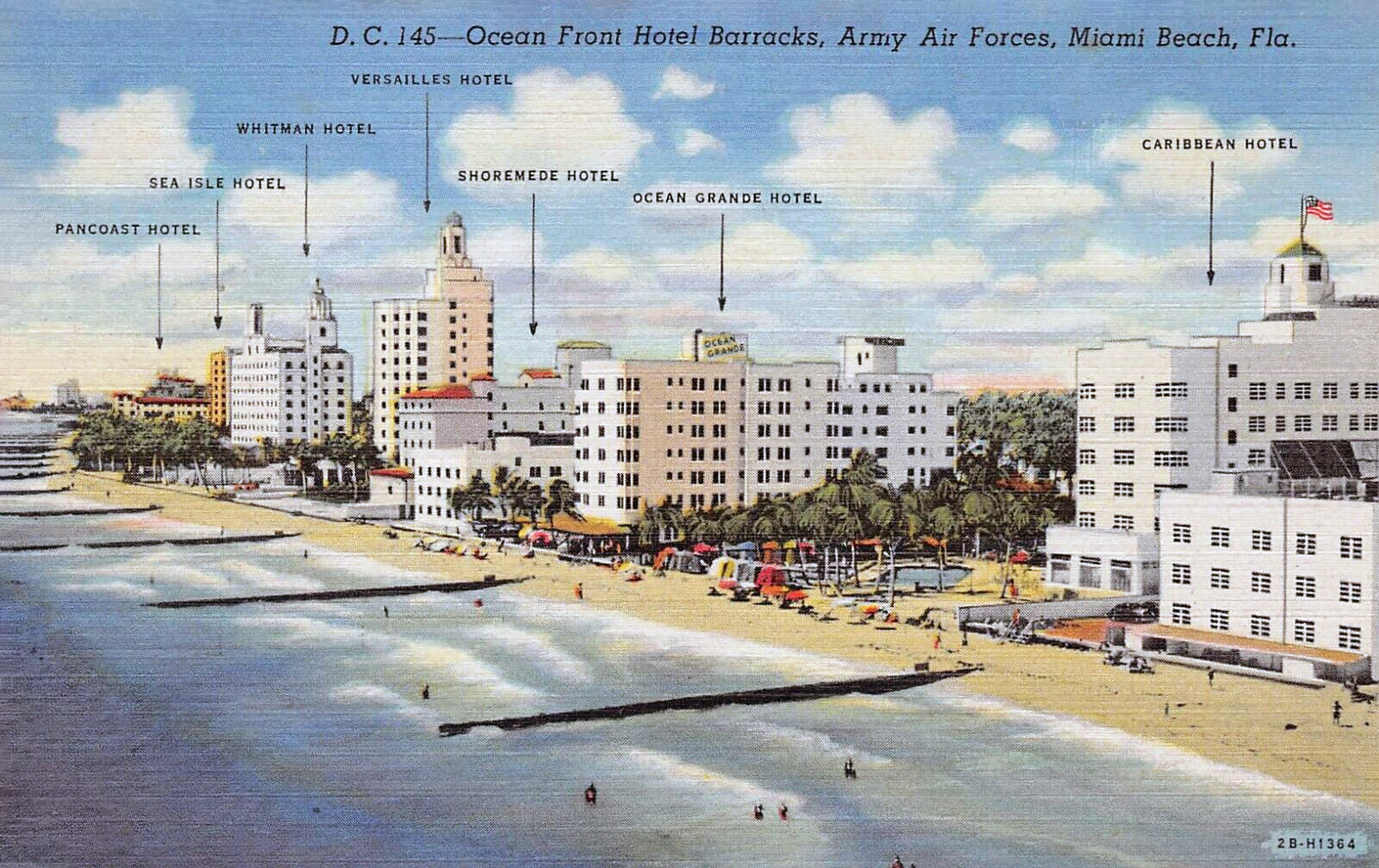
Historical note — the Sea Isle, holdovers, and the planes over the beachThe Sea Isle Hotel stood at 3025 Collins Avenue, in the oceanfront row that also held the Pancoast, Whitman, Versailles, and Shoremede — all of them barracks by 1943. Holdovers were a regular by-product of emergency leave: a man’s original flight shipped on schedule, and he returned to a hotel full of strangers. Office work in personnel — typing morning reports, tracking who was present for duty — was the usual way the Army used a man who could write a clean hand while he waited for a new shipment order.
The aircraft he saw “skimming the water” were almost certainly trainers or coastal-patrol types working the beachfront. Miami and the nearby naval air stations flew a mix of light trainers and patrol planes; he recognized the silhouette from the alfalfa forced landing by Fort Pillow next to the home farm (see the note and photograph above). His original classmates, he now learned, had already been sent on to college detachments in Tennessee, Wisconsin, and Illinois. Mail later came back stamped for Knox College, Galesburg, Illinois — “That’s where I would be now if I hadn’t came home.”
Dear Sister John, Got your letter this morning and enjoyed it very much. Am still in the dark about what I am going to do now. […] Went to a swell movie last nite, saw "Casablanka", a town in North Africa. Also saw a news picture of the invasion of North Africa. Actual pictures taken during the battle. […] Have two roommates now. They are nice guys. One is a Meteorologist Candidate and one has just finished Drill Instructor's school. […] Saw a Commercial Appeal this morning. your bud, Austin
Historical note — 14 March 1943Casablanca had had its general U.S. release on 23 January 1943, the day before Roosevelt and Churchill ended their conference in the real city of that name. Austin saw it on a Miami Beach screen three weeks later and spelled the title as he heard it. The newsreel of the November 1942 landings in Morocco and Algeria — Operation Torch — was by then playing in theaters across the country. The Memphis Commercial Appeal was the paper a west-Tennessee family knew.
A meteorologist candidate was being trained for AAF weather work, essential to planning bombardment missions. Drill Instructor school produced the noncommissioned officers who ran the hotel formations Austin had just finished surviving.
The relative freedom of those holdover days felt strange after the rigid schedule of basic training. He swam when he could, walked the beach, and wrote longer letters. One careless afternoon in the sun left him with painful blisters on both shoulders. The Army still had not paid the cadet candidates in full — they had been expected to remain only twenty-five days — and he had to ask home for a twenty-dollar bill by registered mail. He guarded a prisoner accused of stealing. He sat alone in the personnel office while the rest of the section went to the beach. Reveille now came by loudspeaker, a recorded bugle, then band music on every floor of the hotel while the men dressed.
Historical note — pay, rationing, and the home front in March 1943Aviation-cadet candidates were enlisted men until they were formally appointed Aviation Cadets. At a short-stay BTC they often received only a partial or “supplemental” payment. Full settlement waited for the next permanent station. Registered mail was the ordinary way a family sent cash; bank checks were hard for a soldier to cash off post.
On the home front, nationwide point rationing of canned and processed foods had begun on 1 March. Meat, cheese, and fats would go on the ration books on 29 March — the week Austin reached Wisconsin. Gasoline, sugar, coffee, and shoes were already restricted. When he told his mother not to lend the farm truck too freely, he was talking about a vehicle whose tires and fuel were themselves rationed goods.
Orders North
By the last week of March new orders came. On the afternoon of 23 March he was placed on shipping and restricted to quarters. He was the only man in that hotel or training group to go. Trucks that same week were unloading “about 50 truck loads of troops from New York” arriving for their own turn at the Beach. He left Miami at 8:00 p.m. on Thursday, 25 March.
Hello Mother, How is Tennessee weather now? I've changed from one extreme to the other. It's really cold here but I think I'll enjoy it fine. I'm in a room with 9 boys from Penn but I think this is only our temporary placings. We were greeted by the towns folks who seemed glad to have soldiers come. I think we are quarintened for at least one week so won't have a chance to look it over much. Really had a nice train trip. Left Miami at 8 PM Thursday. Came through Atlanta Ga., Chattanooga Tenn., Louisville Ky., Indianapolis Ind., Chicago, Ill. and then a good hole Oshkosh, Wisconsin. I can look out the window and see a big lake about 1/2 mile away. Speaking of the train again I slept on an upper berth all the way. Got plenty sleep and we were just over fed with everything. […] We have plenty milk here as this is a dairy country. We are living in the State Teachers College. Going to start classes next week. No one would have guessed of this place for an aviation school. We have two boys from Miami Beach & 300 boys from Jefferson Barracks, Missouri. We are the first ones here so we don't have any upperclassmen I hope. Love Austin
Historical note — 25–28 March 1943, Miami to Oshkosha/c/c Austin H. Winn 96th College Training Detachment (Air Crew) Oshkosh State Teachers College Oshkosh, WisconsinThe route he lists — Miami, Atlanta, Chattanooga, Louisville, Indianapolis, Chicago, Oshkosh — is the ordinary wartime rail corridor from South Florida into Wisconsin. An upper berth on a Pullman was the cheaper, less roomy of the two beds in a section. Jefferson Barracks, just south of St. Louis, was one of the Army’s oldest and busiest reception posts; hundreds of its recent graduates were being fed into the new college program at the same moment.
The “big lake” outside the window was Lake Winnebago. Oshkosh State Teachers College — now the University of Wisconsin Oshkosh — had been selected as one of more than 150 civilian campuses to host an Army Air Forces College Training Detachment. Campus records confirm that the first body of cadets, about four hundred men, arrived in the early hours of 28 March 1943. Austin was in that first group. Swart Hall and other campus buildings were converted into barracks. The town turned out to greet them.
Historical note — reading the Oshkosh addressa/c/c (also written A/C/C) means Aviation Cadet Candidate — not yet a rated Aviation Cadet, but no longer a recruit in basic training. 96th College Training Detachment (Air Crew) was the official designation of the AAF unit stationed at the college. Mail had to carry that line. A first envelope that omitted a word was, as Austin told his mother, the wrong address; he corrected it at once.
The College Training Program itself ran from March 1943 to June 1944. General Henry H. Arnold created it to hold a backlog of nearly 100,000 aircrew applicants and to repair gaps in mathematics and physics before preflight school. At its peak more than 60,000 men were on campuses at once. Course work, taught by college faculty, included mathematics, physics, current history, geography, English, and civil air regulations. Military officers ran drill, inspections, and physical training. Length of stay ran from about two months to five, according to how much schooling a man still needed. Some detachments later added a few hours of light-plane indoctrination. Classification as pilot, bombardier, or navigator still lay ahead.
Austin noticed the change in climate and in treatment at once: reveille at 6:30 instead of 5:15, cafeteria meals served by women who “treat us as if we were their own sons,” a merit-and-demerit system that could take away a weekend. Failing to salute an officer cost nine demerits. Hands in pockets cost two. He weighed 172 pounds. Classes were to begin on 1 April. Meat rationing began in the United States the same week he sat down to write that Oshkosh, by gosh, was a real nice place.
The letters from Miami Beach closed the same way they had begun on the Dixieland — with steady affection and the promise to write again soon. The war had taken him far from the familiar fields at Cherry, and it had already cost him his father. The connection to home remained the one fixed point in a life that was otherwise being remade, day by day, under military order.