Two Engines
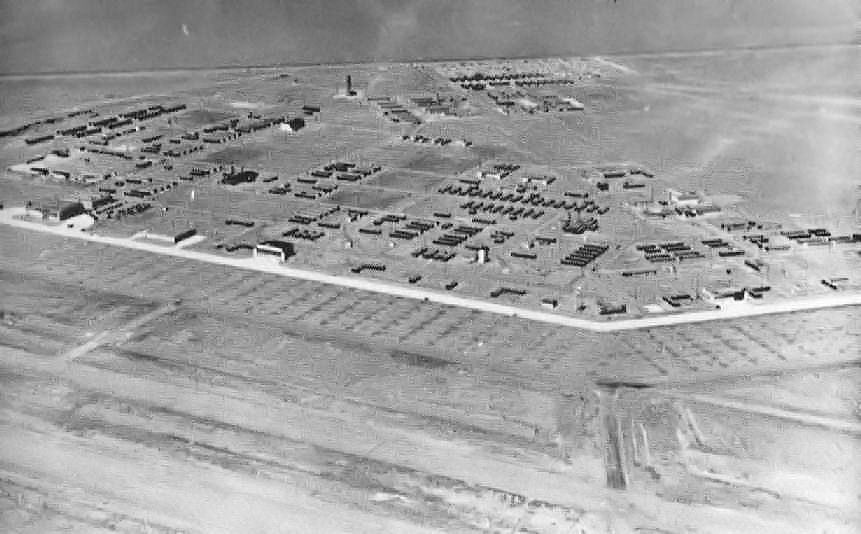
Marfa Army Air Field, Texas · February–April 1944
He finished basic on the morning of 3 February: seventy hours in the Vultee, sixty already in the Ryan at Dos Palos. Shipping orders named Texas — “the same place I mentioned before.” A two-day pass in Los Angeles, Frank Sinatra in Higher and Higher, a bracelet engraved, then a train east at 11:30 on the night of the 6th.
Dear Mother, Hello from Los Angeles. […] We'll be over 2 days on the trip to Marfa - Have you found it in the map yet? Well, Mother'll be flying a 2 engine plane at this next field. They say they are really easier to fly than the B.T.s were though. The only thing is they just fly along straight & level in these trainers & don't get any fun doing acrobatics etc. (ha) I should have been a fighter pilot I guess the way I like to wring the planes out. Love to all Austin
Historical note — Marfa Army Air Field and the AT-17Marfa Army Air Field (he abbreviated it M.A.A.F. and M.A.A.B.) sat on the high desert of West Texas, a few miles from a town he spelled Morfa and judged a little larger than Henning. It was an advanced twin-engine school in the Western Flying Training Command. Colonel Wynne directed training. Dust storms could cut visibility to fifty yards. Coal stoves heated the barracks.
The airplane was the Cessna AT-17 Bobcat — two engines, a wooden wing, fabric over much of the rest, called the Bamboo Bomber by men who did not entirely trust it. Advanced twin training taught a pilot and a co-pilot to work as a crew: takeoff, instruments, radio range, and long cross-countries over country so empty that a forced landing might wait a long time for help. First solo in the AT-17 was two cadets swapping seats, no instructor aboard.
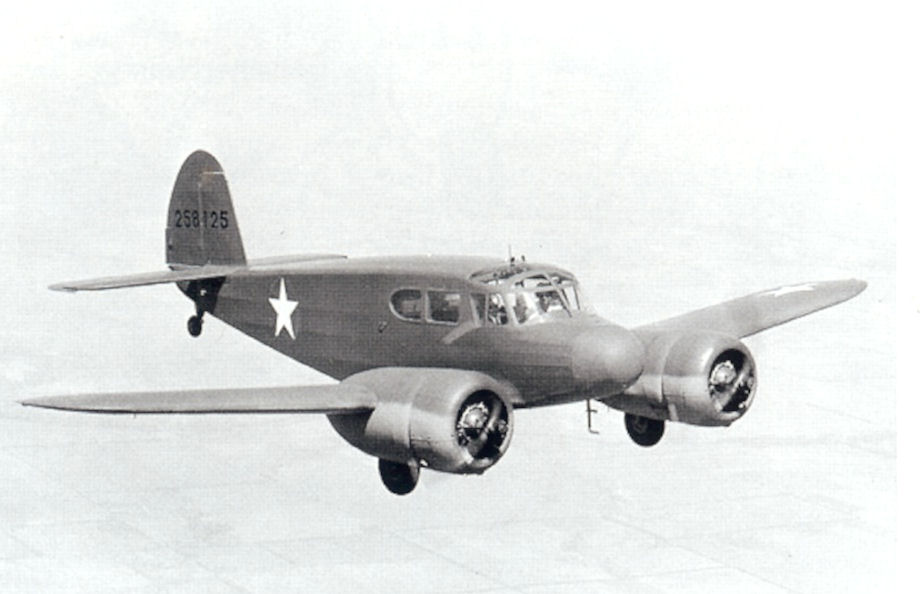
He met Lt. DuBois on Saturday the 12th and flew the AT-17 that next week. Alden V. Winn from the same name and the same mail slot was on the field with him; the school split them to different instructors. Robert Zulany rode as co-pilot before he had soloed. Ground school, running, tumbling, sulphur tablets for colds, and a map of the farm from Sister arrived in the same week. Graduation was set for mid-April. He ordered Hart Schaffner & Marx uniforms before he had the bars.
Hello folks, Am writing toite from the USO at Morfa. The 44C class graduated today […] there was a formation of 36 planes flew over the field in review. […] I took a 200 mile cross-country flight under the hood […] When we go on these XCs we carry some candy apples oranges etc & cantens of water with us just in case we do need them. The country around here is so thinly populated if we were forced down on the desert we might have quiet a while to wait before any help would get to us. […] Have an idea I'll go to New Mexico for my next base if I get through here OK. […] They help raising the standards with each class as they don't seem to need pilots as bad as navigators & bombardiers. Loads of Love Austin
Historical note — radio range and March 1944The radio range was four courses of Morse code laid over the landscape. In one pair of quadrants a man heard A (dit-dah); in the other, N (dah-dit). On the beam itself the two signals merged into a steady hum. Louder meant toward the station; fading meant he had flown through it. On 3 March a sergeant flying with Austin as observer admitted he did not know where they were. They tuned the range and rode the hum home.
Cross-countries stacked up: Pecos, Salt Flat, Van Horn; El Paso and back, 400 miles before dinner; then a 946-mile day through Amarillo, Abilene, and Big Spring. On the night of 27–28 March the desert took its tax. One ship ran short of gas and sat at Wink until morning. Two men landed gear-up at Pyote. Alden Winn lost first one engine, then the other, and put the AT-17 down wheels-up half a mile from the field. No one was hurt. The damaged airplanes, Austin wrote, ran into big money.
Overseas, Cassino was being fought to rubble. The first American daylight raid on Berlin had gone in on 6 March. Jack was in the Marshalls. Sister was waiting on a baby. The class still did not know whether the bars in April would be gold for a second lieutenant or blue for a Flight Officer.
He finished his flying time early in April and rode as co-pilot so a classmate could catch up. Skeet, lectures from men back from combat, dust so thick “you need a gas mask.” Graduation moved from the 13th to the 15th, with exercises on the 14th and a promised NBC broadcast from the field. The printed invitation said what the letters had been aiming at for a year:
Austin H. Winn Pilot, Air Corps Army of The United States The Army Air Forces Pilot School of Marfa, Texas announces the graduation of Class 44-D on Saturday, April the fifteenth nineteen hundred and forty-four Marfa Air Base Post Theater
Historical note — wings, 15 April 1944Class 44-D received wings at Marfa on 15 April. Austin came out a second lieutenant, serial O-774857 — the O- prefix marked a commissioned officer; the old enlisted ASN 14166970 was behind him. Ten days’ leave, most of it eaten by the trip. He reached Cherry in time to see his nephew, John Winn. Then El Paso, a morning in Juárez, and a Greyhound north to Roswell.